
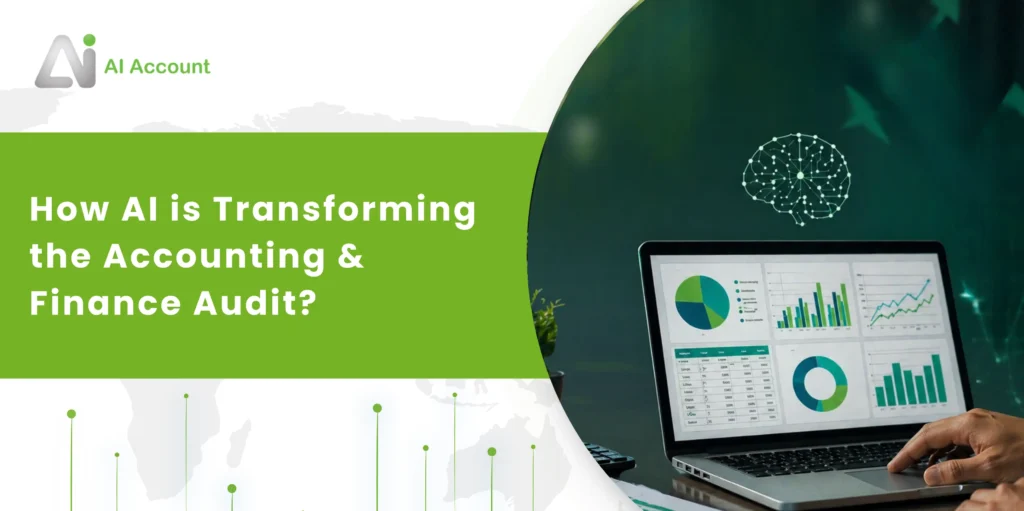
How AI is Transforming the Accounting & Finance Audit?
How quickly is artificial intelligence reshaping accounting and financial auditing? AI in accounting is projected to reach 67.07 USD Billion by 2035, driven in large part by growing adoption among small and medium-sized businesses.
At the same time, organisations are operating within a landscape defined by growing data volumes, evolving compliance requirements, and heightened expectations around transparency and control. This has created pressure on traditional systems and workflows, which were not designed to operate at this level of speed or complexity.
Artificial intelligence is emerging within this context as part of a broader shift in how financial information is processed, interpreted, and used. Its adoption reflects a move toward more integrated and responsive finance operations, where the focus is increasingly on informing decisions rather than simply recording past activity.
This article explains how AI is transforming accounting and finance audit, and what it means for businesses adapting to a more technology-driven financial environment.
- What is AI in Accounting and Finance Audit?
- Why Traditional Accounting and Auditing Are No Longer Enough?
- How AI is Changing Financial Audit Practices?
- How is AI Simplifying Invoices, Payments and Accounts Management?
- How is AI Making Tax Compliance Easier and Smarter?
- How is AI Helping Businesses Forecast Finances More Accurately?
- How is AI Improving Financial Reporting and Regulatory Compliance?
- Conclusion
- Frequently Asked Questions
What is AI in Accounting and Finance Audit?
Artificial intelligence in accounting and auditing uses machine learning, natural language processing, and automation to analyse financial data, perform routine accounting tasks, and identify irregularities or risks in financial records. It represents a shift from manual, sample-based review toward continuous, system-driven analysis, allowing a larger share of transactions to be examined with greater speed, consistency, and accuracy.
1. Automated Auditing
AI is starting to take on a role long handled by auditors themselves: reviewing large volumes of journal entries and invoices and surfacing anomalies, duplicate entries, and potential fraud, gradually easing the profession’s dependence on manual sampling.
2. Faster Financial Close
3. Risk Assessment
4. Intelligent Documentation
Why Traditional Accounting and Auditing Are No Longer Enough?
By 2026, the limitations of traditional accounting and auditing are becoming increasingly evident, as artificial intelligence has shifted from a supporting role to a central part of financial operations, extending beyond routine automation into end-to-end processes and the analysis of substantially larger portions of available data.
1. Shifting Financial Demands
Looking at the future of AI for finance and accounting, traditional systems will increasingly struggle to keep pace with modern financial demands, as artificial intelligence has moved beyond a supporting role to become central to how work is carried out.
2. Limits of Manual Systems
Traditional accounting and auditing still depend heavily on manual processes and periodic reviews, an approach that is proving increasingly inadequate as financial data is generated at greater speed, scale, and complexity.
3. Gaps in Audit Coverage
Sampling-based audits, long treated as standard practice, offer only a partial view of financial activity, leaving open the possibility that irregularities and risks fall outside the scope of review.
4. Delays in Financial Visibility
Periodic reporting structures can delay the recognition of financial issues, limiting how quickly businesses can respond as conditions change or new risks emerge.
How AI is Changing Financial Audit Practices?
Artificial intelligence is changing how financial audits are carried out, moving them away from a sample-based process toward one that is more continuous and driven by data. As routine tasks are handled by automated systems and anomalies are identified earlier, auditors are shifting from manual checks to more analytical work.
Continuous Audit Environment
AI in financial accounting has made audits no longer limited to reviewing transactions to be reviewed on an ongoing basis, making it possible to identify issues closer to when they occur rather than after the fact.
Improved Audit Consistency
By applying the same rules across datasets, artificial intelligence reduces variation in audit outcomes, contributing to a more consistent review process.
Deeper Transaction Insights
Artificial intelligence is giving auditors a closer view into financial data, allowing them to examine relationships within it and identify patterns and connections that are not easily detected through traditional review methods.
How is AI Simplifying Invoices, Payments and Accounts Management?
Artificial intelligence is transforming how routine financial operations are carried out, easing the frictions that often accompany invoicing, payment flows, and account oversight, while allowing those processes to move with greater accuracy and less reliance on manual coordination.
1. Smart Invoice Capture
Artificial intelligence is being used to capture and structure invoice information directly from documents, reducing the need for manual interpretation and improving the reliability of the data.
2. Dynamic Payment Processing
Payments are increasingly being processed with greater adaptability, as systems adjust to transaction patterns and help reduce mismatches across records.
3. Centralised Account Oversight
Artificial intelligence is enabling a more unified view of accounts, allowing financial data to be organised and accessed in ways that support greater control and coordination.
4. Exception Handling Efficiency
Artificial intelligence is being used to identify and separate unusual transactions or discrepancies for review, allowing routine operations to continue with fewer interruptions.
How is AI Making Tax Compliance Easier and Smarter?
Artificial intelligence is changing how tax compliance is handled, moving it away from a largely manual and backwards-looking process toward one that is more proactive and data-driven. By taking on routine tasks, reviewing large volumes of data for inconsistencies, and keeping up with regulatory changes, these systems are allowing tax professionals to work more quickly, reduce errors, and focus more on advisory work than on data entry.
Automated Data Processing and Entry
Artificial intelligence is being used to process financial documents through technologies such as optical character recognition, allowing invoices, receipts, and bank records to be read and structured automatically, reducing the time required for manual data entry.
Automated Reconciliation
Artificial intelligence tools are being used to compare sales and purchase data across filings, allowing invoices to be matched and discrepancies to be identified, reducing manual effort and the likelihood of errors in VAT and GST compliance.
Pre-Filled Returns
Tax authorities are beginning to use artificial intelligence to pre-fill tax returns, simplifying the filing process for both individuals and businesses.
Virtual Tax Assistance
Artificial intelligence–powered assistants are being used to respond to routine taxpayer queries on deadlines and filing requirements, providing timely support and improving access to basic tax-related information.
How is AI Helping Businesses Forecast Finances More Accurately?
1. Adaptive Forecasting Models
Forecasting models are becoming less fixed, as projections are adjusted with new financial and operational data, allowing businesses to reflect changing conditions more accurately than before.
2. Scenario Planning Capabilities
Artificial intelligence is enabling businesses to evaluate multiple financial scenarios, allowing them to assess how outcomes may change under different market or operating conditions.
3. Early Signal Detection
Shifts in revenue and cash flow can be identified earlier, giving businesses more time to respond before those changes begin to affect performance.
4. Demand and Revenue Alignment
Artificial intelligence is helping align expected demand with revenue projections, allowing financial plans to more closely reflect underlying business conditions.
How is AI Improving Financial Reporting and Regulatory Compliance?
The table below discusses the importance of AI in financial reporting and regulatory compliance in 2026:
| Area | Traditional Approach | AI-Enabled Approach | Key Benefit |
|---|---|---|---|
| Financial Reporting | Manual preparation of reports with multiple review layers | Manual preparation of reports with multiple review layers | Faster and more consistent reporting |
| Data Accuracy | Dependent on manual validation and reconciliation | Continuous validation using automated rules and checks | Reduced errors and improved reliability |
| Regulatory Compliance | Requires manual tracking of changing regulations | Systems update and align with evolving compliance requirements | Better adherence to regulatory standards |
| Disclosure Management | Time-intensive preparation of financial disclosures | Automated extraction and organisation of disclosure data | Improved efficiency and transparency |
| Audit Readiness | Documents are prepared periodically for audits | Real-time maintenance of organised financial records | Enhanced audit preparedness |
| Monitoring and Controls | Reactive monitoring through periodic reviews | Continuous monitoring of transactions and controls | Early identification of compliance risks |
Conclusion
Artificial intelligence is beginning to reshape the assumptions on which the profession has long relied, from how risk is identified to how tax returns are filed to how businesses understand their financial position. What is taking place is less a routine technological upgrade and more a structural change in how roles and responsibilities are defined.
AI Account offers a cloud-based accounting software that helps automate routine tasks such as invoicing, reconciliation, and financial reporting, while ensuring compliance with evolving regulations. Our system allows businesses to manage multiple entities, access real-time financial data, and reduce manual workload through automation, making it easier to maintain accuracy and control.
Ready To Start Audit & Finance With Smarter AI
Learn how AI Account supports modern accounting processes and helps businesses adapt to a more technology-driven financial environment.
Recent Blogs

AI Account Participates in MIA International Accountants Conference 2026 in Kuala Lumpur

How AI in Accounting is Transforming the Future of Accounting Firms
How AI is Reshaping Modern Accounting Practices in 2026?

-
Tommy Teo
(Author)