


Tax & Compliance
GST, SST, VAT, and Sales Tax — handled the way regulators expect
AI Account is built to support GST, SST, VAT, and Sales Tax across different jurisdictions, accounting methods, and regulatory requirements.
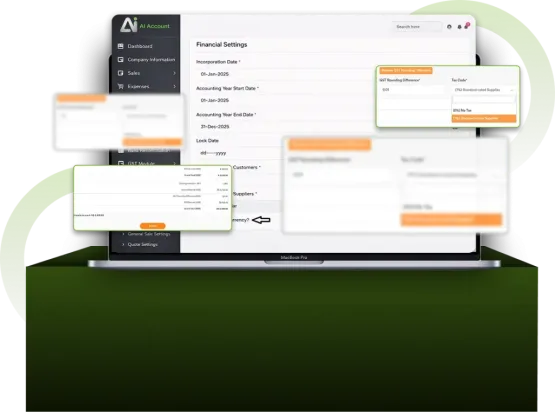
What Tax & Compliance Covers
Tax & Compliance in AI Account allows you to:
- Configure GST, SST, VAT, and Sales Tax codes
- Report tax on accrual or cash basis
- Track GST Payables accurately
- Handle bad debts and unpaid creditors correctly
- Record reverse charge for imported services
- Process batch tax adjustments with audit traceability
This module works alongside Sales, Expenses, Transactions, and General Ledger without duplicating tax records.
GST, SST, VAT, & Sales Tax Setup
AI Account supports tax configuration through Tax Codes.
Tax Code Configuration
Go to Settings → Tax Codes to:
- Set up GST, VAT, or SST
- Select Sales Tax and/or Expenses Tax types
- Add country- or city-specific tax codes if not available by default

Inventory Code and Name can be used as filters when generating inventory reports.
- Important
Do not use the same tax code for both Sales and Expenses. This may prevent proper e-invoice issuance and cause omissions in certain scenarios.
Accrual Basis Vs Cash Basis Tax Reporting
The AI Account allows switching between accrual and cash-basis reporting without complex settings.
GST Payables Account
GST Payables AcGo to Settings → Tax Codes to:
- 2-4000 GST Payables
Tax payments to authorities are posted to this account.

GST Rounding Adjustments
GST rounding differences can be recorded directly.
Steps
Go to Settings → Tax Codes to:
- Click Add GST Rounding Difference
- Enter positive or negative difference
- Select the correct tax code
- Submit to record the transaction
- The adjustment appears in the correct GST report category.

Functional Currency vs GST Currency
In countries where GST must be reported in a specific currency (e.g. SGD):

Setup
- Go to Financial Settings
- Enable Show GST Currency
Transaction Entry
- A GST exchange rate field appears
- Use system or manual exchange rate
- GST is calculated in the reporting currency
Bad Debts and Unpaid Creditors (Accrual Basis)
AI Account provides controlled methods for recording payments across multiple invoices while preserving receivable and payable accuracy.
Bad Debts – Accrual Basis
Where allowed by local regulations, GST paid on unpaid sales can be claimed back.
AI Account supports:
- Receivable write-offs and bad debt reversals
- GST refunds and repayment adjustments
- Accurate GST reporting on write-offs
- Real-time report updates

Scenarios handled:
- Paying SST/GST after 12 months despite non-payment
- Preventing double payment when customers later pay
- Writing off bad debts and claiming refunds
- Handling customer wind-ups before 12 months

Quantities and costs are updated automatically.
Batch GST Adjustments (Bad Debts & Unpaid Creditors)
AI Account includes a GST Module for batch processing.
What You Can Do
- Write off unpaid debtor invoices older than 12 months and claim tax
- Reverse input tax for unpaid creditor invoices older than 12 months
Key Rules
- Select invoices with the same GST rate only
- Do not mix trade and non-trade items
- Use country-specific templates
- Each processed invoice is tagged for audit traceability
- Batch processing eliminates the need for one-by-one journal posting.

Steps:
- Create a reverse charge tax code in Settings → Tax Codes
- Select the reverse charge code when recording imported expenses
The system automatically:
- Records journal entries
- Reflects transactions in the GST report

Understand How Transactions Flow Through the System
Tax & Compliance follows defined accounting and tax logic for reporting, adjustments, and reconciliation.

Keep Tax Records Accurate and Compliant
Configure tax codes, manage accrual and cash basis reporting, and handle GST adjustments with clarity and control.
Frequently Asked Questions
What taxes does AI Account support?
AI Account supports GST, SST, VAT, and Sales Tax through configurable tax codes.
Can I switch between accrual and cash basis GST reporting?
Yes. AI Account allows switching without complex configuration.
Where is GST payable recorded?
All GST, SST, and VAT amounts are recorded under account 2-4000 GST Payables.
How are GST rounding differences handled?
Rounding differences can be recorded directly by selecting the correct tax code.
Can I claim GST on bad debts?
Where permitted by local regulations, AI Account supports GST recovery through structured journal entries.
How are unpaid suppliers handled?
If required, previously claimed input tax can be reversed and later reclaimed upon payment.
Does AI Account support reverse charge?
Yes. Reverse charge can be recorded using dedicated tax codes.
How does AI Account handle different currencies for GST reporting?
GST can be reported in a specific currency even if the functional currency differs.
Can I process GST adjustments in bulk?
Yes. The GST Module supports batch processing with audit trails.
Are GST adjustments traceable?
Yes. All batch adjustments are tagged to invoices for audit review.
