

Inventory
Track, Value, and Adjust Inventory with Accounting Accuracy
Record, value, and adjust inventory using structured methods that keep your financial reports accurate and consistent.
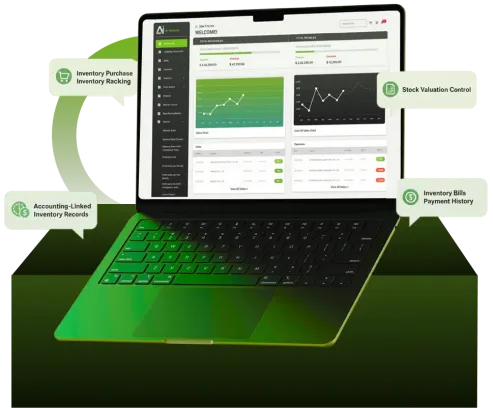
What Inventory Covers in the AI Account
AI Account supports inventory management through clearly defined accounting methods. You can track items, value inventory, record adjustments, and manage raw materials or work-in-progress without distorting your Profit & Loss or Balance Sheet.
Inventory can be recorded using either a perpetual or periodic method, depending on how detailed your stock tracking needs to be.
Inventory can be recorded using either a perpetual or periodic method, depending on how detailed your stock tracking needs to be.

Item setup & SKU control
Inventory tracking
Perpetual inventory method
Periodic inventory method
Moving average valuation
Inventory adjustments
Raw materials & WIP
Cost of goods sold automation
Items Setup
Inventory Code and Name
Each inventory item is identified using an Inventory Code and an Inventory Name.
- Inventory Code must be unique and does not allow duplicate entries
- Inventory Name can be duplicated to track similar items
Example:
- Code: 001 | Name: iPhone | Description: iPhone 17 Pro
- Code: 002 | Name: iPhone | Description: iPhone 17 Pro Max

Inventory Code and Name can be used as filters when generating inventory reports.
Inventory Tracking
- Tracking is used for internal purposes, such as keeping track of where inventory is stored
- Tracking information appears in the Inventory List
- Inventory lists can be exported and used for stock-taking

Tracking can be left blank if it is not needed.
Inventory Recording Methods
Perpetual Method (Inventory Module)
How the Inventory Module works
- Inventory is recorded using a perpetual method with moving average cost
- Inventory purchases are recorded as Inventory (Balance Sheet), not as expenses
- When items are sold, the system automatically transfers inventory to Cost of Goods Sold
- Opening and closing inventory do not appear as P&L lines
- Inventory balances remain on the Balance Sheet
Accounting logic
- Inventory Purchase:
Dr Inventory / Cr Accounts Payable - Inventory Sale:
Dr Accounts Receivable / Cr Sales
Dr Cost of Goods Sold / Cr Inventory
Important constraint
- Inventory entries must be recorded in chronological order
- Purchases must be entered before sales to ensure correct average cost calculation
Periodic Method (Without Inventory Module)
Day-to-day recording
- Purchases recorded in All Expenses and mapped to Cost of Goods Sold Dr COGS / Cr Accounts Payable
- Sales recorded in All Sales
Dr Accounts Receivable / Cr Sales
Period-end manual journals
- Closing Inventory:
Dr Inventory / Cr Cost of Sales - Closing Inventory:
Dr Inventory / Cr Cost of Sales
Other manual adjustments
- Increase Inventory: Dr Inventory / Cr COGS
- Decrease Inventory: Dr COGS / Cr Inventory
- Write-off: Dr Inventory Write-off / Cr Inventory
Inventory Adjustments
AI Account provides controlled methods for recording payments across multiple invoices while preserving receivable and payable accuracy.
Quantity Adjustments
Adjustments are recorded through Inventory Purchase.
- Negative quantity is used to write off inventory
- A non-inventory line is added for Inventory Adjustment Expense
- Tax is set to “No Tax”
- When the invoice total is zero, no trade payable is created
Resulting entry
- Dr Inventory Adjustment Expense
- Cr Inventories

Cost-Only Adjustments
Cost-only adjustments are also recorded through Inventory Purchase.
- Offset quantity lines are used to keep the quantity unchanged
- Inventory Adjustment Expense is used for the value difference
- No trade payable is created
Resulting entry
- Dr Inventories
- Cr Inventory Adjustment Expense
Raw Materials & Work-in-Progress (WIP)
Raw materials and finished goods are recorded using inventory adjustments.
Example:
- Raw materials (e.g. Phone Casing, Phone Battery) are deducted at the average cost
- Finished goods (e.g. iPhone) are added to the rolled-up total cost
- Tax is set to “No Tax”
Optional:
- Non-inventory expense lines may be added to transfer related costs into inventory

Quantities and costs are updated automatically.
Understand How Transactions Flow Through the System
Inventory follows defined accounting logic for valuation, posting, and reporting across the system.

Manage Transactions Without Losing Control
Record, adjust, and settle transactions with accuracy as your volume grows.
Frequently Asked Questions
What inventory recording methods are supported in AI Account?
AI Account supports both perpetual and periodic inventory methods. The perpetual method uses the Inventory module with moving average cost, while the periodic method relies on Sales, Expenses, and manual journals.
Can I switch between perpetual and periodic methods?
You should not mix inventory methods for the same items or accounting period, as this can lead to double-counting. Choose one method per period.
How is Cost of Goods Sold calculated under the perpetual method?
Cost of Goods Sold is automatically calculated at the point of sale using the moving-average inventory cost as of that date.
How do inventory adjustments affect accounting records?
Inventory adjustments are recorded through Inventory Purchase and generate the appropriate accounting entries without creating trade payables when the total amount is zero.
Can raw materials and finished goods be handled without a manufacturing module?
Yes. Raw materials can be converted into finished goods using inventory adjustments, with costs rolled up into the finished item.
