
How Singapore SMEs Reconcile Supplier Statements Before Payment
Imagine your supplier's statement says S$10,900 is owing, your ledger says S$6,900, and a credit note sits somewhere in between. Supplier statement reconciliation in Singapore is how you turn two disagreeing balances into one payment you can defend. In this blog, we explain how Singapore small and medium-sized enterprises (SMEs) reconcile a supplier statement against the accounts payable ledger before releasing payment — which documents to gather, how to match line by line, a worked cutoff example, the Goods and Services Tax (GST) treatment of supplier credit notes, and the controls that should sit behind every approval.
What Is Supplier Statement Reconciliation in Singapore?
A supplier statement is your supplier's own record of your account: the invoices issued, the credits raised and the payments they have applied. The reconciliation is the check that compares their statement with your accounts payable ledger at one common cutoff date, then refreshes both sides through to the day you actually pay.
Why does this matter before payment? A statement printed at month-end can omit a payment that has already left your bank account. It can also omit a credit the supplier agreed but posted after their cutoff. Paying an unreconciled statement risks duplicate payments, missed credits and GST figures that will not survive review.
Our team's recommended sequence is to reconcile at a common cutoff, then review later activity before payment. This is unreviewed model-drafted guidance, not confirmed practitioner practice; have a practitioner confirm it before publication.
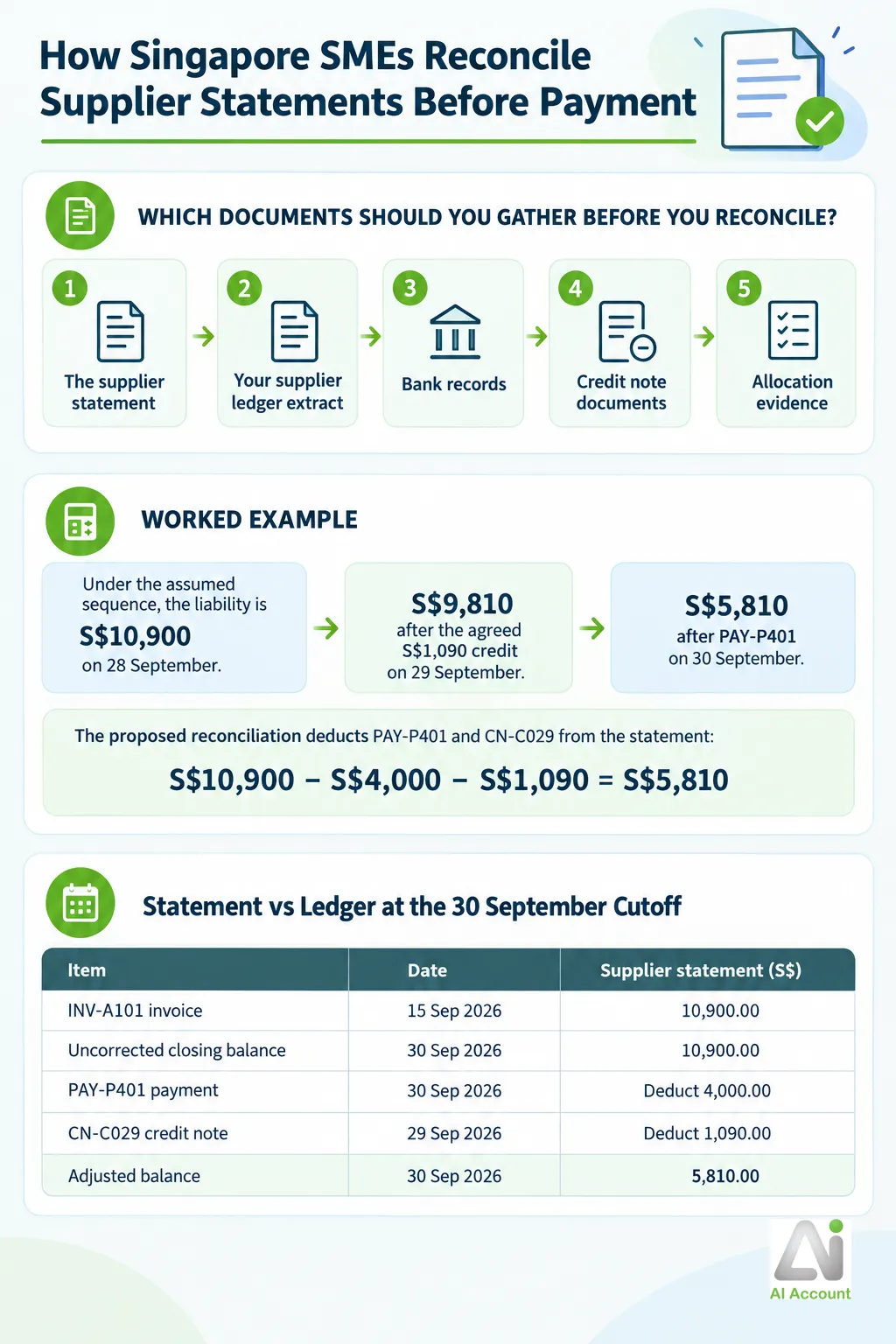
Which Documents Should You Gather Before You Reconcile?
You need the statement itself, your own ledger extract, and the evidence behind every item that will not match cleanly. Gathering these first keeps the reconciliation moving instead of stalling on missing PDFs. The ledger extract may come from AI Account, but the available export fields still need to be checked against the current product before you rely on them. Our team's proposed working set is:
1. The supplier statement
Ask for the statement as issued, and note its cutoff date and currency. A summary balance alone is not enough; you need the line detail behind it.
2. Your supplier ledger extract
Pull the transaction detail from the period start through your intended payment-run date. Useful information includes document and posting dates, document type, reference, currency, original amount and outstanding amount. These are information requirements, not verified AI Account export columns.
3. Bank records
A bank debit is your evidence that a payment left your account on a given date. Keep it with the reconciliation, not only in the bank feed.
4. Credit note documents
Keep the supplier-issued credit note that identifies the supply it adjusts. Also retain evidence that the return or adjustment was accepted, and check for duplicates.
5. Allocation evidence
Where the statement does not show how a payment was applied, ask the supplier for their allocation. A remittance advice proves your instruction, not their receipt.
How Do You Match the Statement with Your Ledger?
Our team recommends matching document references and allocation evidence, not amounts alone. A practitioner should confirm this method; the fields and matching capabilities have not been tested in AI Account.
Keep an untouched cutoff extract and supporting evidence. A spreadsheet is one possible working method, not a demonstrated product workflow. Check the AI Account guide for current report and export documentation before relying on any field. The differences table below the article compares timing items, corrections and supplier queries.
Step 1: Fix a common cutoff
Compare both reports at the same cutoff, such as the last day of the month, then refresh activity through the payment date.
Step 2: Match references, not amounts
Agree items on document reference, date and type. Where references differ, query them before the money moves.
Step 3: Trace payments in transit
A payment recorded by the buyer but allocated later by the supplier may be a timing difference. Confirm the bank record and supplier allocation before adjusting the statement-side working; do not record the same payment twice.
Step 4: Check every credit is allocated
A supplier total may reconcile while a credit remains unallocated to the invoice selected for payment. Check allocation evidence and the payment proposal; this is a hypothetical risk, not a verified AI Account behaviour.
Step 5: Classify and document each difference
Label every gap as timing, correction or query, and attach the evidence. An unlabelled residual is where overpayment hides.
Timing Difference, Ledger Correction or Supplier Query?
| Symptom | Likely cause | Your action | Evidence to attach |
|---|---|---|---|
| Payment missing from statement | Supplier has not allocated it yet | Treat as timing; do not repost | Bank debit and allocation date |
| Credit missing from statement | Supplier posted it after cutoff | Deduct on your working; no entry | Credit note PDF with issue date |
| Credit missing from your ledger | Document not yet entered | Post the entry once verified | Credit note PDF and return evidence |
| Neither side shows agreed credit | Disagreement on entitlement | Raise a supplier query | Correspondence and order records |
| Totals agree but detail differs | Allocation or reference error | Query before paying | Remittance and allocation advice |
What Does a Reconciliation Around a Cutoff Look Like?
Illustrative example — synthetic data. Every figure, date, reference and source document below is hypothetical and needs practitioner confirmation; this is not a client case or an AI Account export.
Assume supplier invoice INV-A101 is dated 15 September 2026 for S$10,900, including S$900 GST. An agreed return generates credit note CN-C029 dated 29 September for S$1,090, including S$90 GST; the buyer receives it on 3 October. The buyer records payment PAY-P401 for S$4,000 on 30 September. The supplier posts the credit on 1 October and allocates the payment on 2 October.
On those assumptions, the supplier's statement through 30 September shows S$10,900 and the buyer's uncorrected ledger shows S$6,900. The proposed reconciliation deducts PAY-P401 and CN-C029 from the statement: S$10,900 − S$4,000 − S$1,090 = S$5,810. On the ledger side, S$6,900 − S$1,090 also gives S$5,810. This is a hypothetical remaining liability, not automatically the amount contractually due on 5 October; terms, approvals, disputes and later transactions still need review.
The proposed classification treats PAY-P401 as a timing item if the bank record and supplier allocation substantiate it, rather than recording the payment twice. The credit's absence from the statement may reflect the supplier's posting cutoff; its absence from the buyer's ledger may require correction once the note and return are verified. The cutoff circumstances and appropriate recognition date need confirmation. Query the supplier if either item cannot be substantiated.
A proposed payment note would identify the cutoff, both adjustments, PAY-P401's bank and supplier allocation dates, CN-C029's issue and receipt dates, the adjusted balance, supporting evidence and any unresolved queries. This is a proposed control, not an actual firm record. Confirm the accounting recognition date and any product tax-period handling separately; no backdated posting route has been tested.
Statement vs Ledger at the 30 September Cutoff
| Item | Date | Supplier statement (S$) | Your ledger (S$) | Classification |
|---|---|---|---|---|
| INV-A101 invoice | 15 Sep 2026 | 10,900.00 | 10,900.00 | Matched on reference |
| Uncorrected closing balance | 30 Sep 2026 | 10,900.00 | 6,900.00 | Gap explained below |
| PAY-P401 payment | 30 Sep 2026 | Deduct 4,000.00 | Already recorded | Timing — supplier allocates 2 Oct |
| CN-C029 credit note | 29 Sep 2026 | Deduct 1,090.00 | Enter 1,090.00 | Correction plus supplier cutoff |
| Adjusted balance | 30 Sep 2026 | 5,810.00 | 5,810.00 | Agreed |
How Should You Treat the GST on a Supplier Credit Note?
Singapore's prevailing GST rate for standard-rated supplies is 9%, and input-tax claims are subject to conditions. () In the synthetic example, assume the supply was standard-rated and the buyer was eligible to claim the original S$900 input tax in full. The S$1,090 credit then comprises S$1,000 before GST and S$90 GST. Under those assumptions, it reduces the payable by S$1,090, reverses S$1,000 of the original purchase or asset cost, and reduces recoverable input tax by S$90. There is no rounding difference: 9% of S$1,000 is exactly S$90. The figures and assumed tax treatment need practitioner confirmation; the IRAS rate does not verify this transaction.
Separate financial recognition from GST reporting. Inland Revenue Authority of Singapore (IRAS) Box 7 guidance requires a deduction for reduced GST incurred on taxable purchases where valid credit notes have been received. Apply it to the actual credit, original input-tax claim and circumstances; exceptions and corrections may need separate review.
IRAS's published cash volume-rebate example reduces the customer's input-tax claim in the return period when the credit note is received, so a GST practitioner should confirm the reporting period for this synthetic goods return. The proposed September liability correction and October GST treatment can be kept distinct, but the recognition date and AI Account tax-period handling need to be tested before publishing a posting route. ()
Keep the PDF with the reconciliation, not in an inbox.
E-invoicing raises the stakes. Under the GST InvoiceNow Requirement — a joint IRAS and Infocomm Media Development Authority (IMDA) initiative — credit notes are treated as invoice data in the guide. Businesses applying for voluntary GST registration from 1 April 2026 must generally submit invoice data to IRAS via the InvoiceNow network, subject to exclusions and GST group rules; other eligible registrants are phased in from April 2028. Our InvoiceNow Singapore page outlines what this means for registered businesses, and because these mandates evolve in phases, it pays to stay up to date with government regulations rather than assume last year's rules.
When Does the Amount You Actually Pay Change?
Our team's proposed approach separates the historical cutoff from the amount reviewed for a later payment run. Payment eligibility depends on the actual terms and evidence.
Illustrative example — synthetic data: under the assumed sequence, the liability is S$10,900 on 28 September, S$9,810 after the agreed S$1,090 credit on 29 September, and S$5,810 after PAY-P401 on 30 September. Receiving the note on 3 October does not create a second credit. A note dated before cutoff is not sufficient on its own: check whether the underlying adjustment existed at cutoff. These dates, amounts and recognition assumptions need confirmation.
If the proposed 5 October run is delayed to 2 November, refresh activity and due dates without rewriting the September reconciliation. If an additional synthetic S$2,180 invoice dated 20 October is approved, undisputed and due on 2 November, the proposed run would be S$7,990. With no additional eligible activity it might remain S$5,810, subject to the actual terms and approvals. The scenario and payment eligibility need confirmation; the timeline table below is illustrative.
How the Proposed Payment Changes by Date
| Date | Event | Liability (S$) | Effect on the payment run |
|---|---|---|---|
| 28 Sep 2026 | Invoice recorded | 10,900.00 | Baseline liability |
| 29 Sep 2026 | Credit agreed and dated | 9,810.00 | Reduce by 1,090 |
| 30 Sep 2026 | S$4,000 payment made | 5,810.00 | Reduce by 4,000 |
| 3 Oct 2026 | Credit note received | 5,810.00 | No second reduction |
| 5 Oct 2026 | Planned payment run | 5,810.00 | Pay if approved and due |
| 2 Nov 2026 | Run delayed; new invoice due | 7,990.00 | Add 2,180 if approved |
Which Reconciliation Traps Catch Bookkeepers Out?
Our team highlights the following payment-workflow risks. Test them in your own system before relying on any default behaviour — they are general risks, not verified claims about any product's allocation engine.
1. The right total, the wrong invoice
In the synthetic example, an unallocated S$1,090 credit could leave the invoice showing S$6,900 while the supplier-level working balance is S$5,810. Selecting the larger invoice amount could overpay by S$1,090. The figures need practitioner confirmation, and this is not a verified AI Account allocation behaviour or payment default.
2. Comparing reports from different dates
As a proposed control, preserve the original cutoff extract before corrections and compare any later extract using identical filters. Confirm the report behaviour in your own system. Otherwise you compare a corrected September ledger with an October statement and manufacture a fresh discrepancy.
3. Treating every difference as timing
A credit never recorded, or an amount the supplier disputes, needs an entry or a query. Labelling it timing quietly builds overpayment into the run. When in doubt, query first and assess any payment against the actual terms and approvals.
What Controls Should Sit Behind the Payment Approval?
A payment decision should be reviewable on its own: the cutoff, the adjustments, the evidence, the queries and the approvals, all in one place. The checklist below is a proposed control design, not an IRAS prescription or evidence of our actual controls or approval roles. Common fields include:
- supplier code, statement cutoff and currency
- statement balance and ledger balance
- invoice references, plus the credit note's reference, issue date and receipt date
- payment reference, bank date and the supplier's allocation date
- links to evidence: invoice, credit note, bank record, return acceptance
- timing adjustments and any required ledger entries
- GST treatment and reporting period
- adjusted balance, amount due now and unresolved queries
- preparer, reviewer and payment approver, each dated
In this design the bookkeeper prepares, the finance manager reviews the reconciliation and the credit entry, and the owner or authorised bank signatory releases payment. The preparer never approves their own work. Any change to supplier bank details goes through a separate verification using a contact you already trust — never the contact details inside the change request.
Clean reconciliations also feed the financial statements behind your Year of Assessment (YA) 2026 Corporate Income Tax (CIT) Return. IRAS requires companies to file their YA 2026 CIT Returns by 30 November 2026, unless a waiver to file has been granted. Check your authorisation matrix and system capabilities before adopting the proposed roles.
Start with a common cutoff, match references and allocations, then refresh the evidence before payment. Keep the reconciliation and approvals together, and distinguish the cutoff balance from the amount due now.
Talk to the AI Account team about your payables requirements and verify the relevant product capabilities before relying on them.
Get Your Payables Ready for the Next Payment Run
Talk to our team about ledger extracts, credit note handling and payment controls in AI Account — built for Singapore SMEs and the firms that serve them.