
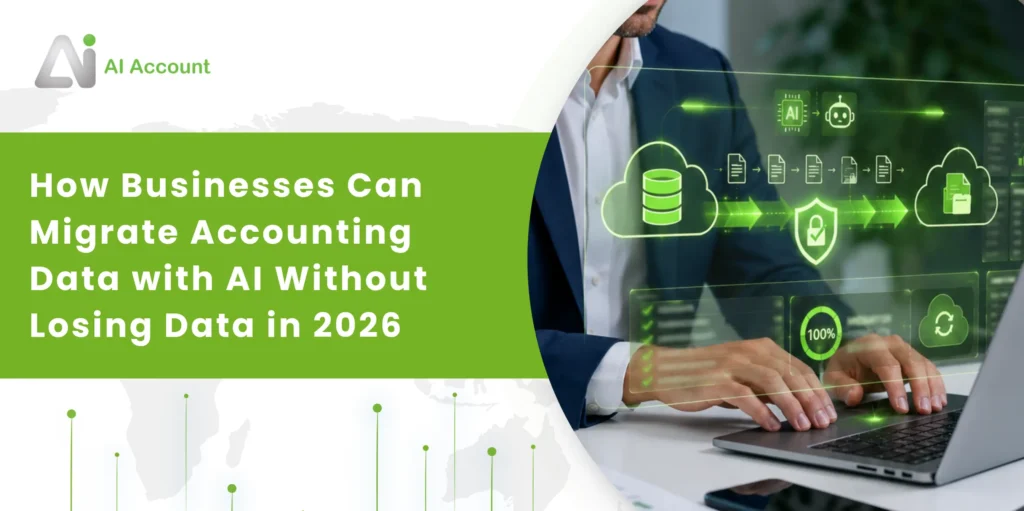
2026 Guide to AI in Accounting: Trends, Tools & Use Cases
Artificial Intelligence is changing the way businesses handle their finances faster than ever before. According to a Grand View Research report, the market is expected to surge from $4.8 billion in 2024 to nearly $97 billion by 2033, indicating that companies worldwide are rapidly shifting to smarter, automated systems.
Businesses are transitioning from manual processes and traditional tools to cloud-based accounting software and AI-powered automation that operate continuously in the background.
This guide explains how AI and accounting work together, provides real use cases and benefits, and explains how companies can choose the right accounting software solution to automate more work with confidence.
- What Is AI in Accounting and How It’s Evolving in 2026?
- How AI Is Transforming Daily Accounting Workflows?
- Real Use Cases: How Businesses Apply AI Across Finance Functions
- Key AI Trends That Will Shape Accounting in 2026 and Beyond
- Benefits of AI for Finance Teams and Accounting Firms
- Challenges Companies Face When Adopting AI in Accounting
- How to Choose and Implement AI Accounting Tools Effectively?
- Conclusion
- Frequently Asked Questions
What Is AI in Accounting and How It’s Evolving in 2026?
AI in accounting refers to the use of machine learning, predictive analytics, automation, and document intelligence to streamline core finance tasks.
Unlike traditional accounting software, which relied heavily on manual inputs and fixed rules, artificial intelligence in accounting now learns from historical data, adapts to new patterns, and continuously improves accuracy without requiring constant human intervention.
From rule-based automation to intelligence
- AI reviews financial data and automatically categorises it, eliminating the need for manual bookkeeping.
- Modern systems understand transaction patterns rather than relying on fixed rules, thereby improving accuracy over time.
- Companies using AI-enabled accounting software report up to 80% faster reconciliation and a 90% reduction in manual data entry.
From manual supervision to autonomous workflows
- Modern cloud accounting software now runs tasks such as reconciliation, categorisation, and compliance checks in real-time.
- Month-end closing and error-checking are much faster, freeing accountants to focus on strategy and planning.
- Workflows update automatically as new data is received, providing teams with real-time, reliable insights.
From standalone tools to integrated ecosystems
- AI is now embedded in online accounting systems, ERP platforms, expense management tools, and AP/AR automation solutions.
- This integration creates a connected financial ecosystem, ensuring accuracy, compliance, and smarter financial decisions every day.
How AI Is Transforming Daily Accounting Workflows?
1. Bookkeeping becomes continuous
2. Reconciliations complete automatically
3. Document-heavy tasks are simplified
4. Compliance moves from reactive to proactive
5. Reports are generated faster
AI-powered cloud-based accounting software compiles financial data, fills gaps, and produces draft reports automatically.
Overall, AI replaces manual effort with continuous, automated workflows that help teams stay ahead, rather than catching up.
Real Use Cases: How Businesses Apply AI Across Finance Functions
Companies of all sizes now use AI accounting tools to simplify processes that once required hours of manual effort. From bookkeeping to reporting, AI is helping finance teams work more efficiently, reduce errors, and make more informed decisions.
- Automated Transaction Categorisation: Classifies transactions with high accuracy.
- Smart AP/AR Workflows: Detects duplicates, manages payments, and predicts late payments.
- AI-Powered Expense Management: Extracts details from receipts, ensures policy compliance.
- Anomaly and Fraud Detection: Flags suspicious transactions and prevents errors.
- Continuous Close & Real-Time Reporting: Updates financial data instantly for actionable insights.
- Predictive Financial Forecasting: Provides forward-looking insights for revenue, cash flow, and expenses.
This example demonstrates how AI in accounting, when integrated with cloud-based accounting software, can transform financial operations, enhancing accuracy, efficiency, and strategic decision-making at scale.
Key AI Trends That Will Shape Accounting in 2026 and Beyond
Predictive and prescriptive analytics
AI is enabling finance teams to shift from analysing what happened to predicting what will happen next. Modern AI accounting tools can:
- Forecast revenue, cash flow, and expenses with high accuracy
- Recommend actionable steps based on data trends and insights.
- Reduce reliance on static spreadsheets for decision-making.
According to Mordor Intelligence’s AI in
Accounting Market Growth Trends and Forecast by 2030, predictive and prescriptive analytics are expected to drive 30–40% faster financial planning cycles for businesses using AI-powered systems.
GenAI copilots integrated into accounting software
Conversational AI is becoming a standard feature in cloud accounting software, helping accountants work more efficiently. These AI copilots can:
- Summarise financial statements automatically
- Draft reports in minutes instead of hours
- Explain account variances in plain language.
- Analyse large datasets and generate actionable insights
This reduces research and reporting time by up to 50%, allowing teams to focus on strategy rather than manual analysis.
Autonomous AP/AR systems
Accounts payable and receivable are becoming largely self-operating. AI can:
- Match invoices and purchase orders automatically
- Detect duplicate or fraudulent transactions.
- Manage payment schedules and reminders.
By automating these processes, finance teams can focus on cash flow optimisation and vendor management, increasing operational efficiency by 25–35%.
AI-powered compliance ecosystems
With increasing global regulations, AI tools now help businesses automate compliance tasks. Key capabilities include:
- Tax classification and reporting
- Policy checks and audit trail creation
- KYC and vendor verification
- Continuous monitoring for anomalies
Automation reduces compliance errors by up to 60% while ensuring real-time regulatory compliance.
AI-first cloud accounting platforms
Modern cloud-based accounting software is embedding AI into core workflows, creating fully integrated finance ecosystems. Businesses can now:
- Finance operations on a single platform
- Automate reconciliation, reporting, and forecasting
- Gain real-time insights for strategic decisions.
These platforms support autonomous finance, where AI handles routine work and humans supervise critical decisions, maximising efficiency and accuracy.
Benefits of AI for Finance Teams and Accounting Firms
| Benefit | AI Feature / Function | Impact |
|---|---|---|
| Operational Efficiency | Automated bookkeeping, transaction categorisation, and real-time reconciliations | Reduces manual work by up to 80%, speeds up month-end close |
| Financial Performance | Predictive forecasting, cash flow analysis, and working capital optimisation | Enables accurate, data-driven financial decisions, reduces errors by 20–25% |
| Compliance & Risk Management | Fraud detection, automated audit trails, policy enforcement | Minimises compliance errors by up to 60%, strengthens internal controls |
| Strategic Advantage | Real-time dashboards, actionable insights, scenario planning | Frees accountants to focus on advisory work, strategy, and planning |
Challenges Companies Face When Adopting AI in Accounting
While AI in accounting offers significant benefits, implementing these tools within cloud-based accounting software and online accounting systems comes with its own set of challenges.
Companies must address data, training, and governance issues to achieve successful adoption.
Data readiness and integration issues
- Multiple legacy systems with inconsistent formats
- Missing or incomplete financial data
- Integration issues with existing accounting software solutions
Change management and training
- Learning AI-assisted workflows and interpreting data
- Lack of training can slow adoption.
Governance and privacy concerns
- Managing access rights, security protocols, and vendor risk
- Documenting AI decisions for auditability and compliance
How to Choose and Implement AI Accounting Tools Effectively?
Implementing AI requires selecting the right accounting software solution , reviewing existing processes, and setting achievable automation goals.
Step 1: Assess your current accounting processes
Step 2: Define your automation goals
Decide whether you want to:
- Reduce processing time
- Improve forecasting
- Strengthen compliance
- Speed up the close
Step 3: Evaluate AI capabilities
Look for tools that support:
- Real-time data sync
- Intelligent categorization
- OCR for documents
- Predictive analytics
- Automated workflows
Step 4: Focus on integration compatibility
Choose solutions that integrate with:
- Existing cloud accounting software
- ERP systems
- Payroll system
- Banking APIs
Step 5: Start with a pilot project
Test AI on a single function such as AP, expenses, or reconciliation.
Step 6: Measure ROI and expand
Track improvements in:
- Time saved
- Reduced errors
- Faster close cycles
- Cost efficiency
Then expand AI features across more financial workflows.
Conclusion: What Is the Future of AI-Powered Accounting?
The future of AI accounting is intelligent, automated, and insight-driven. AI does not replace accountants; it amplifies their expertise by automating repetitive tasks and making financial data more actionable.
From automated bookkeeping to predictive forecasting, AI Accounting solutions are redefining how businesses manage finances. By adopting AI-driven, cloud-based systems, accounting teams can shift focus from routine processes to strategic advisory and decision-making.
As more companies adopt software accounting online and advanced cloud accounting software, accounting teams can shift their focus from repetitive tasks to high-value advisory work. The combination of AI and accounting software solutions is creating smarter, faster, and more secure financial management systems for businesses of all sizes.
Investing in the right AI-driven online accounting system is no longer optional, it’s a competitive advantage. Early adopters gain an edge through greater accuracy, efficiency, and strategic decision-making. With expert guidance from AI Account, implementing the right AI accounting solution becomes seamless, scalable, and stress-free.
Let AI Do the Heavy Lifting
Recent Blogs

AI Account Participates in MIA International Accountants Conference 2026 in Kuala Lumpur

How AI is Changing the Way Small Businesses Manage Their Finances?

-
Tommy Teo
(Author)