
AI Bookkeeping for Startups and Small Businesses: A Practical Guide to Smarter Finance
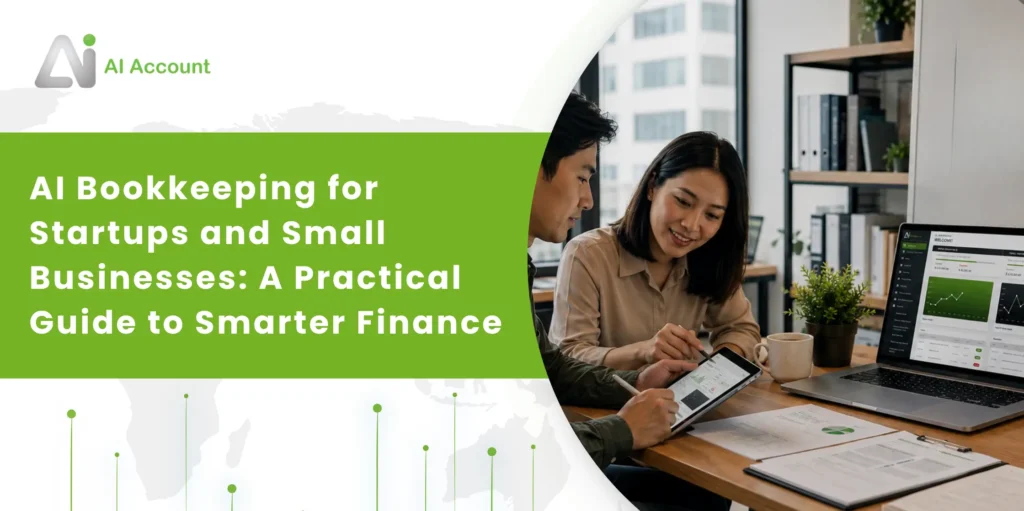
AI bookkeeping is transforming the way startups and small businesses manage finances in 2026. Instead of manual data entry and reactive accounting, businesses are now using AI tools to automate bookkeeping, improve accuracy, and access real-time financial insights.
Recent studies show that AI can reduce manual bookkeeping work by up to 90%, while businesses save 10–20 hours per month on financial administration tasks. At the same time, adoption is accelerating, with over 60% of finance teams exploring AI tools and a growing share already integrating them into daily workflows.
In this blog, we explore how AI bookkeeping works, its key benefits for startups and SMEs, real-world use cases, and what businesses should do to implement it effectively in 2026.
- What is AI Bookkeeping?
- Why are startups and SMEs shifting toward AI-powered bookkeeping?
- How AI Bookkeeping Works in Modern Accounting Systems
- What are the practical use cases of AI bookkeeping for small businesses?
- Traditional Bookkeeping vs AI Bookkeeping
- How can businesses successfully adopt AI bookkeeping in 2026?
- Conclusion
- Frequently Asked Questions
What is AI Bookkeeping?
AI bookkeeping refers to the use of artificial intelligence technologies to automate and enhance the process of recording, organising, and managing a business’s financial transactions.
Unlike traditional bookkeeping, which relies heavily on manual data entry and fixed rules, AI continuously analyses financial data, learns from previous transactions, and improves its recommendations over time.
Modern AI accounting software combines several technologies to automate the bookkeeping process, including:
- Machine Learning (ML): Learns from historical transactions to improve categorisation and identify recurring patterns.
- Optical Character Recognition (OCR): Extracts data from invoices, receipts, and other financial documents without manual entry.
- Natural Language Processing (NLP): Interprets text from invoices and payment descriptions to improve data classification.
- Automation: Processes routine tasks such as reconciliation, reporting, and transaction matching with minimal human intervention.
At its core, AI bookkeeping combines technologies such as machine learning, optical character recognition (OCR), and natural language processing (NLP) to make accounting faster, more accurate, and more efficient.
Why are startups and SMEs shifting toward AI-powered bookkeeping?
Businesses are rapidly adopting AI-powered bookkeeping because traditional accounting methods are no longer efficient enough for fast-growing businesses. As financial transactions increase, manual bookkeeping becomes slow, costly, and error-prone. Here are the key reasons behind this shift:
1. Time & Cost Efficiency
AI significantly improves operational efficiency by reducing manual accounting work.
- Automatically processes invoices, receipts, and bank transactions
- Eliminates repetitive data entry and reconciliation tasks
- Reduces month-end closing time from days to minutes
- Lowers dependency on large accounting teams and reduces bookkeeping costs
2. Improved Accuracy and Reduced Accounting Errors
AI-driven systems enhance financial accuracy and reduce human error in bookkeeping.
- Minimises manual data entry mistakes and missing transactions
- Ensures cleaner, audit-ready financial records for compliance
- Improves consistency in transaction categorisation
- Detects unusual transactions and helps prevent financial fraud
3. Real-Time Financial Reporting and Insights
Unlike traditional accounting, AI enables real-time financial visibility for better control.
- Live dashboards for cash flow, expenses, and profitability
- Instant access to financial performance data instead of month-end reports
- Better cash flow forecasting and financial planning
- Supports data-driven business decision-making
How AI Bookkeeping Works in Modern Accounting Systems?
AI bookkeeping integrates bank feeds, accounting software, and machine learning models to automate end-to-end financial data processing. Instead of manually recording and checking transactions, businesses connect their financial systems to AI-powered platforms that continuously capture, classify, and reconcile data in real time.
Modern AI accounting systems function through four key steps:
1. Data Capture Using OCR and Bank Integration
AI systems first collect financial data from multiple sources such as bank transactions, invoices, receipts, and payment gateways. Using Optical Character Recognition (OCR), the system converts scanned documents and PDFs into structured accounting data. When combined with live bank feeds, this significantly reduces manual data entry.
2. Automated Transaction Categorisation
Machine learning automatically classifies income and expenses into categories such as payroll, rent, travel, or software. It improves over time by learning from past corrections and business patterns.
3. Automated Reconciliation
AI continuously matches bank transactions with invoices and ledger entries in real time, reducing reconciliation time by around 60–70% and quickly identifying discrepancies.
4. Exception Detection & Reporting
The system flags anomalies such as duplicate payments, missing records, or unusual spending patterns, and generates real-time dashboards covering cash flow, expenses, and profit performance.
What are the practical use cases of AI bookkeeping for small businesses?
AI bookkeeping goes beyond automating routine accounting tasks. Modern AI accounting software helps startups and small businesses manage daily financial operations more efficiently, improve cash flow visibility, and make faster business decisions. Here are some of the most common use cases in 2026.
1. Recording Daily Transactions
AI automatically imports and categorises bank transactions, reducing manual bookkeeping and keeping financial records up to date.
2. Processing Invoices and Receipts
Businesses use AI to extract data from invoices and receipts using OCR, eliminating manual data entry and speeding up expense recording.
3. Reconciling Bank Accounts
AI matches bank transactions with invoices and accounting records in real time, helping businesses close their books faster and identify discrepancies early.
4. Managing Cash Flow
By analysing income, expenses, and payment trends, AI provides real-time cash flow insights and forecasts, helping businesses plan for upcoming financial needs.
5. Tracking Business Expenses
AI automatically categorises expenses, identifies duplicate claims, and monitors spending across departments or projects, improving cost control.
6. Preparing Financial Reports
Modern AI accounting software generates real-time Profit & Loss statements, Balance Sheets, and cash flow reports without manual compilation.
7. Supporting Tax Compliance
AI organises financial records, tracks tax-related transactions, and prepares tax-ready reports, making GST, VAT, or corporate tax filing more efficient.
8. Monitoring for Errors and Fraud
AI continuously scans accounting data to detect duplicate invoices, unusual transactions, missing entries, or other anomalies that may require investigation.
9. Managing Accounts Payable and Receivable
Businesses use AI to automate invoice approvals, schedule supplier payments, track outstanding invoices, and send payment reminders to customers.
10. Delivering Financial Insights
Beyond bookkeeping, AI analyses financial data to identify spending trends, profit margins, and cash flow patterns, helping business owners make faster, data-driven decisions.
Traditional Bookkeeping vs AI Bookkeeping
| Traditional Bookkeeping | AI Bookkeeping |
|---|---|
| Manual data entry and transaction recording | Automated transaction capture and categorisation |
| Periodic bank reconciliation | Continuous, real-time reconciliation |
| Paper-based receipts and invoices | OCR-powered digital document processing |
| Financial reports generated at month-end | Live dashboards and real-time reporting |
| Time-consuming error detection | AI-assisted anomaly and fraud detection |
| Reactive financial management | Proactive insights and cash flow forecasting |
How can businesses successfully adopt AI bookkeeping in 2026?
Successfully implementing AI bookkeeping requires more than selecting the right software. Businesses need a clear adoption strategy that aligns with their accounting processes, data quality, and operational goals.
Step 1: Review Your Current Bookkeeping Processes
Start by evaluating your existing bookkeeping workflow to identify repetitive and time-consuming tasks that can be automated. This may include recording transactions, processing invoices, reconciling bank accounts, tracking expenses, or preparing financial reports. Understanding where your team spends the most time helps prioritise automation and ensures a smoother implementation.
Step 2: Select the Right AI Accounting Software
Choose a solution that meets your business requirements and integrates with your existing systems. Look for features such as automated transaction categorisation, OCR-based invoice processing, bank feed integration, real-time reporting, and tax compliance support.
Step 3: Organise and Clean Your Financial Data
AI delivers the best results when working with accurate, well-structured financial information. Before implementation, review your chart of accounts, remove duplicate records, and standardise transaction categories to improve data quality.
Step 4: Integrate Your Financial Systems
Connect your AI bookkeeping solution with bank accounts, payment gateways, payroll, e-invoicing, and other business applications. Seamless integration reduces manual data transfers and creates a single source of financial information.
Step 5: Train Your Team and Monitor Performance
Ensure employees understand how to use AI-powered workflows and review AI-generated outputs regularly. While automation reduces manual work, human oversight remains essential for handling exceptions, maintaining compliance, and continuously improving the system as your business grows.
Conclusion
AI bookkeeping is helping startups and small businesses simplify financial management by automating routine accounting tasks and improving accuracy. With AI accounting software, businesses can save time, gain real-time financial insights, and make faster, more informed decisions.
AI Account offers AI-powered accounting software together in one platform, making it easier to manage finances, stay compliant, and scale with confidence. As AI continues to evolve, adopting intelligent accounting software can help businesses improve productivity, strengthen compliance, and build a finance function that scales with growth.
Simplify Your Bookkeeping with AI Account
Automate everyday bookkeeping tasks, track your finances in real time, and improve accuracy with AI Account’s AI-powered cloud accounting software.
Recent Blogs

Singapore Personal Income Tax Calculator 2026: Estimate Your Tax From Income and Resident Tax Brackets

How Unlimited-Usage Pricing Helps Singapore Accounting Firms Add Clients Without Adding Software Costs

How Much Should Accounting Software Cost for a Growing Singapore Firm in 2026?

-
Tommy Teo
(Author)
Frequently Asked Questions
What is AI bookkeeping?
AI bookkeeping uses artificial intelligence to automate routine accounting tasks such as recording transactions, categorising expenses, processing invoices, reconciling bank accounts, and generating financial reports. It helps businesses save time, improve accuracy, and maintain up-to-date financial records.
How does AI bookkeeping differ from traditional bookkeeping?
Traditional bookkeeping relies on manual data entry and periodic reconciliations, while AI bookkeeping automates these processes using machine learning, OCR, and cloud technology. This enables faster processing, fewer errors, and real-time financial insights.
Can AI replace a bookkeeper or accountant?
No. AI is designed to support, not replace, finance professionals. It automates routine bookkeeping tasks, while accountants continue to provide expert advice, ensure compliance, prepare financial statements, and handle complex accounting matters.
What features should businesses look for in AI accounting software?
When choosing AI accounting software, look for features such as automated transaction categorisation, OCR-based invoice and receipt scanning, bank feed integration, real-time reporting, cash flow forecasting, tax compliance tools, and integration with other business applications.
Is AI bookkeeping suitable for startups and SMEs?
Yes. AI bookkeeping is particularly beneficial for startups and small businesses because it reduces administrative workload, improves financial accuracy, and provides real-time insights without requiring a large finance team. It also scales easily as the business grows.
How can AI Account help businesses with AI bookkeeping?
AI Account combines AI-powered bookkeeping with cloud accounting software to automate transaction processing, invoice management, bank reconciliation, financial reporting, and compliance. This helps startups and SMEs simplify financial management, reduce manual effort, and make faster, data-driven business decisions.